INDIGENOUS NEVADA VOTERS & POLITICAL POWER:
Nevada’s total tribal voter population could decide the fate of Nevada’s electoral vote
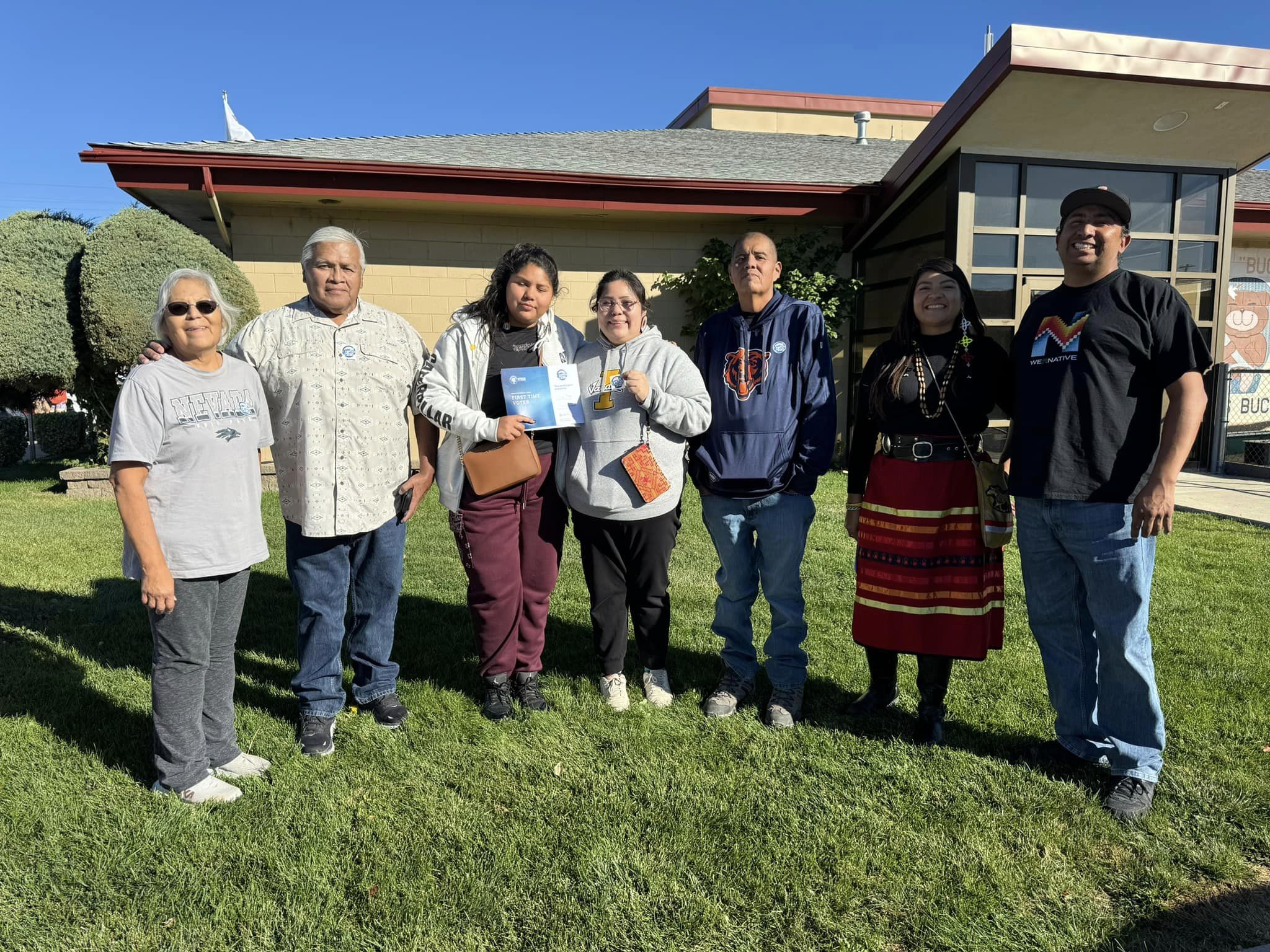
(Reno, NV) – Tomorrow, we will be casting our final votes in 2024 Presidential Election. With Nevada being a battleground state in this election; competitive enough that either Trump or Harris could win by less than 3%; means Nevada’s total tribal voter population could possibly decide the fate of Nevada’s electoral vote. Consequently, it’s important for Nevada’s tribal members to GET OUT THE VOTE.
Nevada has 91,165 Native American Voters, making 3.8% of the voter population of Nevada. Reno-Sparks Indian Colony (RSIC) has about 870 eligible tribal member voters, not including non-members who are residents.
In the 2020 presidential election, Native Americans played a crucial role in Nevada. Voter turnout on tribal lands surged from the 2016 presidential elections and had such a significant impact it helped Biden win Nevada by 2.39%. Leaders behind the Native Vote mobilization efforts in 2020, stated it was the “largest native voter turnout in Nevada’s history”.
"Native Americans in Nevada need to Get Out The Vote in the 2024 Presidential Elections. Nevada Native Americans hold the political power to determine whether the electoral votes go to Trump or Harris; as long as every tribal member votes," stated Daryl D. Gardipe, RSIC Chairman. "Tribes are voting on the protection of tribal sovereignty and upholding the United States to their trust responsibilities to us. Which is why I'm urging you to cast your votes on Election Day, in-person or by EASE Program, if you haven't done so yet."
This 2024 presidential election is critical for tribes. The primary issue is to protect tribal sovereignty and uphold the United States to its trust responsibility to tribal nations. Tribes insist inclusion & tribal consultation on all matters; preservation of lands, language and culture; protection of sacred sites; solutions to MMIP and law enforcement needs; advanced healthcare, including traditional healing; funding for housing & infrastructure; education advancement and truthful tribal history taught in schools; recognition that public lands are native lands; to solve climate change using ancient tribal ecological knowledge; and promote responsible consumerism.
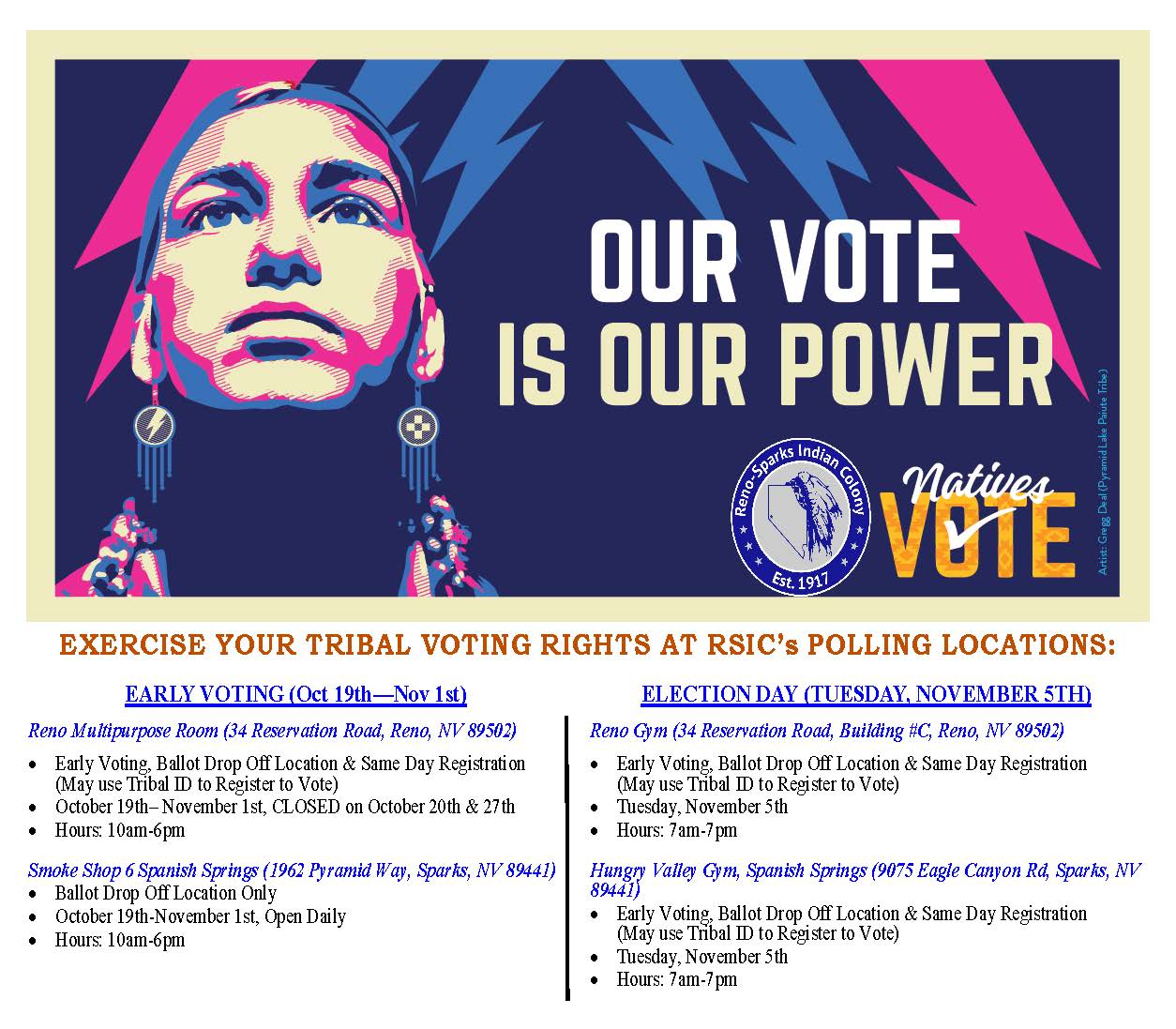
We are building our future together when we use our voices and exercise our rights to vote. The ultimate goal this election is to increase civic engagement by tribal members on reservation and off-reservation.
Civic engagement means working to make a difference in the civic life of our communities and developing the combination of knowledge, skills, values and motivation to make that difference. It means promoting the quality of life in a community, through both political and non-political processes….
A morally and civically responsible individual recognizes himself or herself as a member of a larger social fabric and therefore considers social problems to be at least partly his or her own; such an individual is willing to see the moral and civic dimensions of issues, to make and justify informed moral and civic judgments, and to take action when appropriate.
There are numerous paths for civic engagement:
- Political participation through voting, voter registration, or being an election judge;
- Educating Americans on government and history;
- Volunteering with organizations that build community well-being or participating in community service projects;
- Advocating for legislation and models;
- Representing fellow citizens by appointment or election, such as on a city council or school board.
All of these actions demonstrate how civic engagement is about engaging people in a process of self governance. Values associated with fostering civic engagement are:
- Trusting and respecting how a community wants to take action for itself;
- Creating agency and power in people, particularly those most affected by an issue;
- Nurturing or fostering healthier, stronger, happier places to live;
- Engaging community members in a processes that affect them and their communities;
- Promoting transparency and participation
Even though we had a record native turnout in 2020, we still need to improve voter numbers for 2024. Here are some common reasons for low Native American Voter turnout:
- Geographic isolation, often with lack of reliable transportation and poor access to distant polling and registration locations.
- Non-traditional mailing addresses, overcrowded housing, homelessness, and housing instability.
- Lack of residential mail delivery and limited access to post offices.
- Lack of access to affordable and reliable broadband service.
- Native language translation needs, including non-written, during the voting process.
- Strong socioeconomic challenges, such as poverty and unemployment.
- Historic and ongoing mistrust of state and local governments.
In Nevada, tribal members finally were able to receive voting rights in 1948; 24 years after becoming United States citizens in 1924. Meanwhile, non-native voters have been making the decisions for Nevada Tribal Nations on which Politicians will represent their tribes at a local, state, and federal level. It’s time all tribal members add input on which Politicians they think will protect tribal sovereignty and look out for the best interest of all tribes.
Nevada Tribes were allowed to have their own polling locations after Pyramid Lake Paiute Tribe and Walker River Paiute tribe filed a lawsuit against Nevada, Washoe County and Mineral County in 2016 for failing to provide adequate early voting and Election Day polling locations on their reservations and won. Since then, over 15 Nevada Tribes, including RSIC, have opted in to have local tribal polling locations for their community while building relationships with their county partners. Both tribal members and non-natives vote at these locations.
With the advocacy of Nevada Tribes and the Nevada Secretary of State, Francisco Aguilar during the 2023 legislature session they passed a state law allowing tribal members living on a reservation to use the online voting system called, Tribal EASE Program. This will help alleviate geographic isolation, lack of reliable transportation and poor access to distant polling and registration locations and increase native voter turnout. To learn more about the online voting system, go to www.NVEASE.gov.
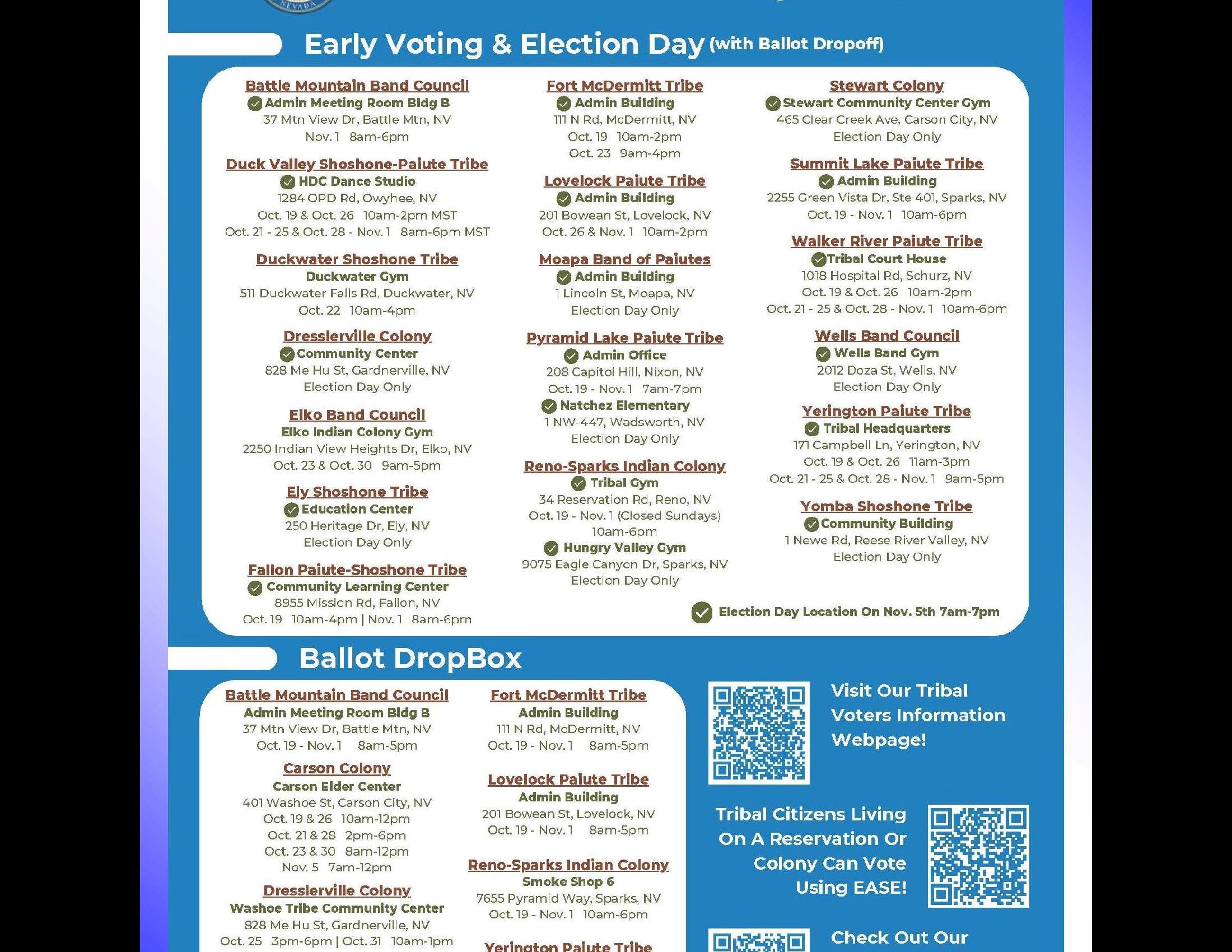 ITS TIME TO GET OUT THE NEVADA NATIVE VOTE! Make Tribal Voices Heard!
Go to RSIC’s Election Day Polling Locations:
- Reno Gym (34 Reservation Road, Reno, NV 89502)
- 7am-7pm
- Same-Day Registration & may use Tribal I.D.
- Vote In-Person
- Hungry Valley Gym (9075 Eagle Canyon Drive, Sparks, NV 89441)
- 7am-7pm
- Same-Day Registration & may use Tribal I.D.
- Vote In-Person